 Printhawk
How to price art prints
Updated
Price an art print from the full cost of one order: the print, shipping, marketplace and payment fees, and a small allowance for reprints. Then add the profit you want and check the result against similar work. A worked example below shows how a print that looks profitable can lose a third of its margin to fees.
Step 1: know your cost per order
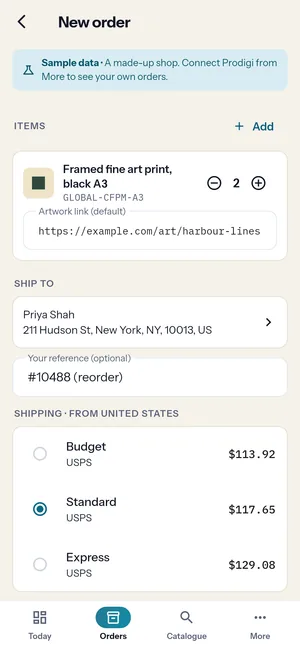
With print on demand, the lab charges you for the product and shipping on each order. Get the real figures from the lab for your main destinations; Prodigi’s are in its dashboard and quote API (see Prodigi pricing). Printhawk’s free catalogue shows a product’s cost to the UK, US, Germany and Australia, and with Pro you can get a live quote for a specific order. Add:
- marketplace fees (on Etsy: $0.20 to list, 6.5% of the order total including shipping, plus payment processing that varies by country);
- Offsite Ads on some Etsy sales (15%, or 12% for shops past $10,000 in a 365-day period);
- a reprint allowance for damage and mistakes;
- sales tax or VAT if you are responsible for it (see VAT on print on demand).
Step 2: a worked example
All numbers in this example are hypothetical, chosen to make the arithmetic clear. They are not real prices from any lab, and the payment processing rate is an example, not Etsy’s rate in your country. The Etsy listing and transaction fees are Etsy’s published fees.
| Line (one A3 print, sold on Etsy) | Amount |
|---|---|
| Item price the buyer pays | $40.00 |
| Shipping the buyer pays | $6.00 |
| Order total | $46.00 |
| Etsy transaction fee (6.5% of $46.00) | −$2.99 |
| Etsy listing fee | −$0.20 |
| Payment processing (example: 3% + $0.25) | −$1.63 |
| Lab: print (example) | −$14.00 |
| Lab: shipping (example) | −$6.00 |
| Reprint allowance (example: 3% of orders × $20.00) | −$0.60 |
| Profit | $20.58 |
| Profit if the sale came from an Offsite Ad (15% of $46.00 = $6.90) | $13.68 |
The print looks like a $26 profit ($40 minus $14). After fees and the reprint allowance it is $20.58, and $13.68 when an Offsite Ad brought the sale. Price for the worse case if many of your sales come from ads. Our profit margin guide turns this into percentages and break-even points.
Step 3: build a size ladder
Area grows fast: A3 is twice A4, and A2 is twice A3. Production cost usually grows more slowly than area, and buyers expect bigger prints to cost more but not double. A ladder where each size up costs noticeably more, but less than double, works for most shops.
| Size | Area vs A4 | Example price (hypothetical) |
|---|---|---|
| A4 | 1× | $28 |
| A3 | 2× | $40 |
| A2 | 4× | $58 |
Check each rung separately: shipping often jumps for larger tubes and framed prints, so a big size can earn less than a small one if you price by area alone.
Step 4: check it against the market
Look at prints by artists at a similar stage, on similar paper, at the same size. If your price is far below, you may be signalling low quality; if far above, you need a reason a buyer can see (paper, edition, signature, framing). Open editions, limited editions and originals are priced on different scales (see limited edition prints).
Mistakes that cost money
- Pricing from the print cost alone and forgetting shipping and fees.
- One shipping price for every size and destination.
- No allowance for reprints after damage in transit.
- Discounts that push the worst-case sale (with ads) below zero.
- Not re-checking when the lab’s prices change: quote again before you change your listings.
Questions
How do you calculate the price of an art print?
Add up the full cost of one order: the print, shipping, marketplace and payment fees, and an allowance for reprints. Then set a price that leaves the profit you want after all of them, and check it against similar prints.
What markup should I use on art prints?
There is no standard markup. One simple starting point is to price at two to three times the print’s production cost, then check that the profit after fees and shipping is worth your time at each size.
Should bigger prints cost more per square inch?
Usually less. An A2 print has twice the area of A3 but rarely costs twice as much to make, so a price ladder where each size up adds less than its extra area keeps big sizes attractive and still profitable.
Do Etsy fees apply to shipping?
Yes. Etsy’s 6.5% transaction fee is charged on the order total, including the shipping and gift wrap you charge, so include shipping when you work out the fee.
Should I offer free shipping on prints?
You can, but the shipping still has to be paid: build it into the price. Etsy’s transaction fee is then charged on a higher item price instead of on shipping, so the fee is the same.
Sources
- Etsy Help, Etsy Fee Basics (help.etsy.com), read 27 November 2026.
- Etsy Help, How Etsy’s Offsite Ads Work (help.etsy.com), read 27 November 2026.
- Worked example: hypothetical figures, arithmetic rounded to the cent. A-size areas from ISO 216.