 Printhawk
Giclée printing: what it is, papers, costs and buying vs selling
Updated
Giclée printing is fine art inkjet printing: a wide-format printer sprays tiny drops of pigment ink onto coated, archival paper or canvas. Done well, it reproduces paintings and photographs with smooth tones and lasts for decades. The paper, the print size and the lab set the price.
“Giclée” is not a different machine or a secret process. It is a name for inkjet prints made to a fine art standard: pigment inks rather than dye inks, papers made for archiving rather than poster stock, and a colour-managed workflow so the print matches the file. The word itself has an odd history (see what is giclée); this page is about how the prints are made, what they are printed on, and what that means if you buy or sell them.
How giclée printing works
- A digital file. A photograph, a digital illustration, or a scan or photograph of a painting. For sharp prints, aim for about 300 pixels per inch at the final size (see 300 dpi).
- Colour management. The printer uses an ICC profile made for that exact paper, so colours land where they should. Hahnemühle publishes profiles for its papers and says every paper needs its own, because each has a slightly different base tone (see colour profiles for printing).
- Printing. A wide-format inkjet printer lays down droplets of pigment ink in many colours. The prints come off the printer one at a time, so one print costs much the same to make as the hundredth.
- Finishing. The print is trimmed, checked, and then packed flat or rolled, framed or stretched over a frame if it is printed on canvas.
Why pigment inks matter
Inkjet printers use either dye inks or pigment inks. Pigments are tiny solid particles that sit on the paper's coating; dyes soak in as a solution. Pigment inks are the ones used for fine art because they resist fading far better. Hahnemühle, the German paper maker, says it profiles printers that use “light-resistant” pigment inks and recommends them for its papers, and that prints with pigment inks can last more than 100 years, citing Wilhelm Imaging Research. Print-on-demand labs say the same in their own words: Prodigi's fine art paper pages describe pigment-based archival inks for its giclée prints.
Giclée papers
Giclée papers are “fine art inkjet papers”: an artist's paper (cotton, alpha-cellulose, or newer fibres such as bamboo) with an inkjet coating on top that holds the ink at the surface for deep blacks and sharp detail. The common choices, with figures from Hahnemühle's own product pages and data sheets:
| Paper | Weight | Fibre | Surface | Optical brighteners |
|---|---|---|---|---|
| Hahnemühle Photo Rag | 188 / 308 / 500 gsm | 100% cotton | Matt, smooth felt texture | Very low |
| Hahnemühle German Etching | 310 gsm | 100% alpha-cellulose, mould-made | Matt, textured | Very low |
| Hahnemühle Bamboo | 290 gsm | 90% bamboo, 10% cotton | Matt, light felt texture | None |
| Hahnemühle Photo Rag Baryta | 315 gsm | 100% cotton | High-gloss baryta | None |
| Hahnemühle FineArt Baryta | 325 gsm | 100% alpha-cellulose | High-gloss baryta | Moderate |
All five are described by Hahnemühle as acid- and lignin-free and conforming to ISO 9706. Matt papers suit paintings, drawings and soft photographs; baryta and other glossy fine art papers suit photographs that need deep blacks and saturation. Our best paper for art prints guide goes through the choice by subject.
Giclée vs lithograph vs C-type
| Giclée | Offset lithograph | C-type | |
|---|---|---|---|
| How it is made | Inkjet printer sprays pigment ink | Ink transferred from plates on a press | Light exposes silver halide photo paper, then it is developed |
| Image structure | Very fine ink droplets | Halftone dots, usually CMYK | Continuous tone, no dot pattern |
| Papers | Fine art papers, canvas, photo papers | Press papers | Photographic paper (gloss, lustre, metallic) |
| Economics | One at a time; suits print on demand | Set-up per run; cheap per copy in long runs | One at a time; suits photo prints |
| Best for | Art reproductions, fine art photography, editions | Large runs of posters and books | Photographs with a classic photo look |
Prodigi's own C-type page describes its C-types as silver halide prints with continuous tone and “no visible dot pattern”, in lustre, gloss and metallic finishes. An original lithograph, drawn by the artist on stone or a plate, is a hand printmaking method and not a reproduction at all.
What drives the cost of a giclée print
- Size. The biggest factor: paper and ink scale with area. An A2 print has four times the area of an A4.
- Paper. Branded cotton papers cost more than house matte papers. On Prodigi's product pages (read 27 November 2026), wholesale prices start from £2.28 for its Smooth Art Paper and from £3.00 for Hahnemühle German Etching and Hahnemühle Photo Rag, for the smallest size, before tax and shipping.
- Finishing. Framing, mounting or stretching on canvas adds far more than the print itself.
- Shipping. Large prints ship rolled in tubes; small ones ship flat. Delivery to another country can cost more than the print.
- Proofing and scanning. For one-off reproductions, a studio may charge for scanning or photographing the original and for test prints.
Buying vs selling giclée through print on demand
If you buy a giclée, ask which paper and ink were used, whether the edition is limited and numbered, and whether the print is signed. “Giclée” on its own is not a quality guarantee, because the word has no legal definition.
If you sell giclées, a print-on-demand lab prints each one when a customer orders, so you hold no stock. Prodigi lists its fine art papers (for example Hahnemühle German Etching and Photo Rag) with Giclée as the printing method and routes orders to its labs in the UK, EU, US and Australia. Order a sample on the paper you plan to sell, name the paper in your listing, and say whether prints are open or a limited edition. Our guide to fine art print on demand compares labs.
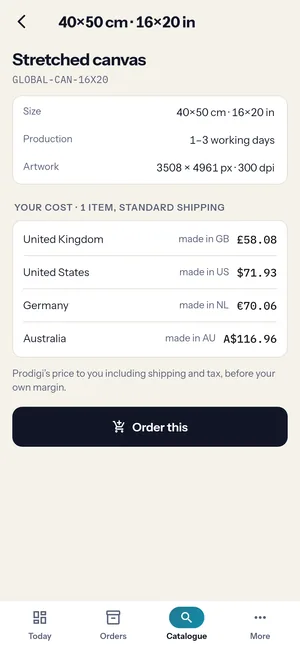
Printhawk, our iPhone app for Prodigi sellers, shows each catalogue size with the pixels your artwork needs and the cost to send it to the UK, US, Germany and Australia, so you can check a paper and size before you list it.
Questions
What is giclée printing?
Giclée printing is high-quality inkjet printing for art and photography: a wide-format printer sprays fine droplets of pigment ink onto coated fine art paper or canvas. Hahnemühle describes a giclée as an artwork or photograph reproduced on an inkjet printer with pigmented, UV-resistant inks on archival paper.
Is a giclée print worth more than a poster?
It usually costs more to make and lasts longer, because it uses pigment inks and archival paper instead of cheaper inks on poster stock. Its value as art depends on the image, the edition and the artist, not on the process alone.
How long do giclée prints last?
It depends on the ink, the paper and how the print is displayed. Hahnemühle says prints made with pigment inks on its papers can last more than 100 years, and that its papers meet the ageing-resistance requirements of DIN 6738. Direct sunlight and damp shorten any print's life.
What is the difference between a giclée and a lithograph?
A giclée is printed by an inkjet printer from a digital file, one print at a time. An offset lithograph is printed from plates on a press, which pays off in long runs. An original lithograph is drawn by the artist on stone or a plate, which is a different thing again.
Can I sell giclée prints through print on demand?
Yes. Several print-on-demand labs print fine art papers on inkjet printers with pigment inks. Prodigi, for example, lists its Hahnemühle German Etching and Photo Rag prints with Giclée as the printing method, and prints each one only after it is ordered.
Sources
- Hahnemühle, Digital FineArt frequently asked questions (giclée, pigment inks, DIN 6738, ICC profiles), hahnemuehle.com, read 27 November 2026.
- Hahnemühle product pages and data sheets: Photo Rag, German Etching, Bamboo, Photo Rag Baryta, FineArt Baryta (hahnemuehle.com), read 27 November 2026.
- Prodigi product pages: Hahnemühle German Etching, Hahnemühle Photo Rag, Smooth Art Paper, C-types (prodigi.com/products), read 27 November 2026.