 Printhawk
Wall art prints: choosing the formats to sell
Updated
Start with three formats: an unframed paper print, a framed print and a stretched canvas, each in three to five sizes that share your artwork’s shape. That covers the cheap, the gift-ready and the statement buyer. Add metal or acrylic later for photography. Check each format’s lead time and where your lab makes it.
The wall art formats compared
“Wall art prints” is searched 12,100 times a month, and the phrase covers very different products. What each means for a seller, using Prodigi’s listed figures from 27 November 2026 as the example:
| Format | Price position | Prodigi production time listed | Ships as | Guide |
|---|---|---|---|---|
| Paper art print / poster | Entry | 24–72 hours | Flat mailer or tube | Art prints |
| Mounted print | Entry plus | 72 hours | Flat mailer | Mounted prints |
| Framed print | Mid to high | 72 hours | Box | Framed prints |
| Stretched canvas | Mid to high | 48–120 hours | Box | Canvas prints |
| Metal (dibond) | High | 72 hours | Double-walled box | Metal prints |
| Acrylic | Top | 192 hours | Double-walled box | Acrylic prints |
| Wall tapestry | Mid | 120 hours | Mailer bag | Tapestries |
Production time is before shipping. A buyer ordering acrylic waits more than a week before it even leaves the lab.
A starter range that works
- Unframed giclée print on a matte fine art paper, in sizes from A4 / 8 × 10 to A2 / 18 × 24. Low price, cheap to ship, easy to gift.
- Framed print of the same artwork in two or three sizes, black, white and natural frames, with an optional mount.
- Stretched canvas in two or three larger sizes, mirror wrap by default so no detail is lost.
Keep all three on one aspect ratio and you can use one master file. Add large canvas, metal or acrylic for photography once the core range sells.
One file, many products: aspect ratio
The biggest time sink in wall art is cropping. A-sizes are 1 : 1.41; 12 × 16 and 18 × 24 are 3 : 4; 8 × 12, 16 × 24 and 24 × 36 are 2 : 3; 16 × 20 and 8 × 10 are 4 : 5. Choose one family per artwork, and only list sizes from it. If you must cross families, make and check each crop yourself. Our aspect ratio guide groups sizes by shape, and art print sizes lists the common ones.
What buyers expect
- Sizes in their units. Give cm and inches; give the outside size for framed pieces.
- Ready to hang, or not. Framed prints from Prodigi arrive with a hook; its cotton canvases do not include hanging equipment. Say which.
- Colour like the photo. Show real product photos or accurate mockups, and add a line about screens varying.
- Arrival undamaged. Big boxed items get knocked. Have a damage process: photos, report to the lab, reprint. See returns and reprints.
Pricing wall art
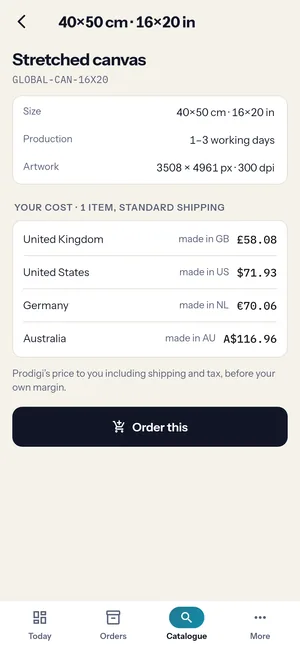
Every format and size has its own cost to make and ship, and shipping varies by destination, especially for boxed pieces. Price each variant from its landed cost (product + shipping + tax) in each region you sell to, then add marketplace fees and your margin. Printhawk’s free catalogue shows a size’s artwork pixels and its cost to the UK, US, Germany and Australia, which makes that table quick to fill in. More in how to price art prints.
Questions
What kind of wall art sells best on print on demand?
Framed prints and canvas are the formats buyers search for most after paper posters. In our keyword data, “canvas prints” is searched 246,000 times a month and “framed prints” 12,100. Start with paper prints plus one framed option, then add canvas.
Should I sell framed or unframed prints?
Both. Unframed prints are the low-price entry and cheap to ship; framed prints raise the order value and suit gift buyers who want something ready to hang.
How many sizes should I offer?
Three to five per format is plenty: a small, a medium and one or two large sizes in your artwork’s aspect ratio. More sizes mean more crops to check and more listing variants to manage.
What resolution do wall art prints need?
300 dpi for prints seen up close, 150–200 dpi for large pieces seen from across a room. A 24 × 36 inch print needs 3600 × 5400 pixels at 150 dpi.
Sources
- Prodigi product pages for enhanced matte art paper, mounted prints, classic frames, stretched canvas, dibond, acrylic panels and wall tapestries (prodigi.com/products/), production times and packaging, read 27 November 2026.
- Google Ads Keyword Planner, “wall art prints”, “canvas prints”, “framed prints”, 27 November 2026.
- Pixel counts calculated from inches × dots per inch.